
Tag: AI search

  • How to Measure Search Visibility in 2026: A Practical Framework

    How to Measure Search Visibility in 2026: A Practical Framework

    A top ranking doesn’t prove your business is being seen or chosen. If you’re asking how to measure search visibility, look beyond positions and clicks. A search result can expose your brand without earning a visit, while an AI answer may mention or cite a competitor instead.

    That’s why familiar reports can seem contradictory. Rankings may rise while clicks fall, and analytics may miss discovery that happens inside an AI answer. The solution isn’t another vanity metric. It’s a repeatable system that connects where your business appears, which searches it appears for, and whether that presence supports a meaningful business outcome.

    This guide sets out a practical framework for 2026. You’ll establish a baseline across traditional search and AI experiences, group queries and prompts by audience intent, and track visibility, citations, qualified visits, and conversions. You’ll also learn how to interpret changes without overreacting to one ranking shift or AI response, then use the evidence to decide what to improve.

    Key Takeaways

    • Define visibility by more than rankings: separate exposure, brand mentions, citations, visits, and business outcomes.
    • Build a consistent baseline by grouping target queries, mapping relevant pages, and comparing Search Console data over time.
    • For how to measure search visibility across AI platforms, track a stable prompt set and record where your brand appears, which sources are cited, and the answer context.
    • Read impressions, positions, clicks, and conversions together to identify where search presence needs attention.
    • Use a monthly review to investigate changes, prioritize improvements, and record what happens next.

    What Does Search Visibility Measure, and What Does It Miss?

    Search visibility is the degree to which your business can be discovered across relevant queries, traditional search results, and AI-generated answers. It describes your presence across a defined set of searches and platforms, not a single rank or traffic report. Each measure captures a different stage of discovery.

    Search visibility measures opportunities for your brand to be seen or cited; traffic measures visits, and business outcomes measure what those visits achieve. This distinction aligns with foundational search engine optimization principles: visibility depends on how your pages appear in search, but appearance alone doesn’t tell you whether someone clicked, visited, or converted.

    Keep these signals separate in your measurement framework:

    • Impressions: Recorded exposure in a search result or platform, according to that platform’s reporting rules.
    • Rankings: A page’s position for a particular query in a particular search context.
    • Mentions: Your brand is named in an AI-generated answer, whether or not a source link appears.
    • Citations: An AI answer references or links to your website as a source.
    • Clicks and visits: A searcher follows a result to your site and begins a session.
    • Qualified visits and conversions: Visitors match your intended audience or complete a meaningful action.

    These signals connect, but none represents all the others. A citation may build recognition without a visit. A visit may show interest without producing a lead or sale. Tracking each stage helps you see where discovery happens and where it stops.

    Search visibility versus rankings, impressions, and traffic

    Rankings describe position; impressions indicate recorded result exposure. Clicks and website visits capture what happens next, not every opportunity someone had to see your brand. The measures can move in different directions. A page may gain impressions for more queries while its average position falls, increasing exposure but reducing clicks if it appears lower or less prominently.

    One keyword position can’t represent an entire brand’s search presence. A business may rank well for one narrow query yet remain absent from searches tied to other services, questions, or purchase stages. Assess presence across relevant query groups, pages, and platforms instead of treating one fluctuating position as a verdict.

    Why zero-click and AI search change the measurement picture

    A person can see a brand in a search result, read an AI summary, or encounter a cited source without visiting the website. A search may answer the user’s question directly on the results page, leaving no outbound click to record. That exposure can still influence what the person remembers or considers, but standard website analytics won’t capture every interaction.

    AI signals also need precise labels. A mention means the answer names your brand; a citation means it points to your content as a source. Neither automatically proves a recommendation, a site visit, or a business result. AI outputs can vary, and reporting coverage differs by platform. No single metric captures every search experience, so how to measure search visibility starts with combining signals while keeping their limits clear.

    How to Measure Traditional Search Visibility Consistently

    A reliable traditional search measurement process needs a stable query set, relevant landing pages, and comparable reporting periods. Without that structure, changes in rankings or traffic can look meaningful when the query mix has simply shifted.

    A useful search visibility baseline records performance for a defined query set, its mapped pages, and a specific date range. Build the baseline before making changes, then keep the method consistent. Guidance such as Digital.gov SEO best practices also emphasizes user-focused discoverability: measure whether the pages appearing in search meet searchers’ needs.

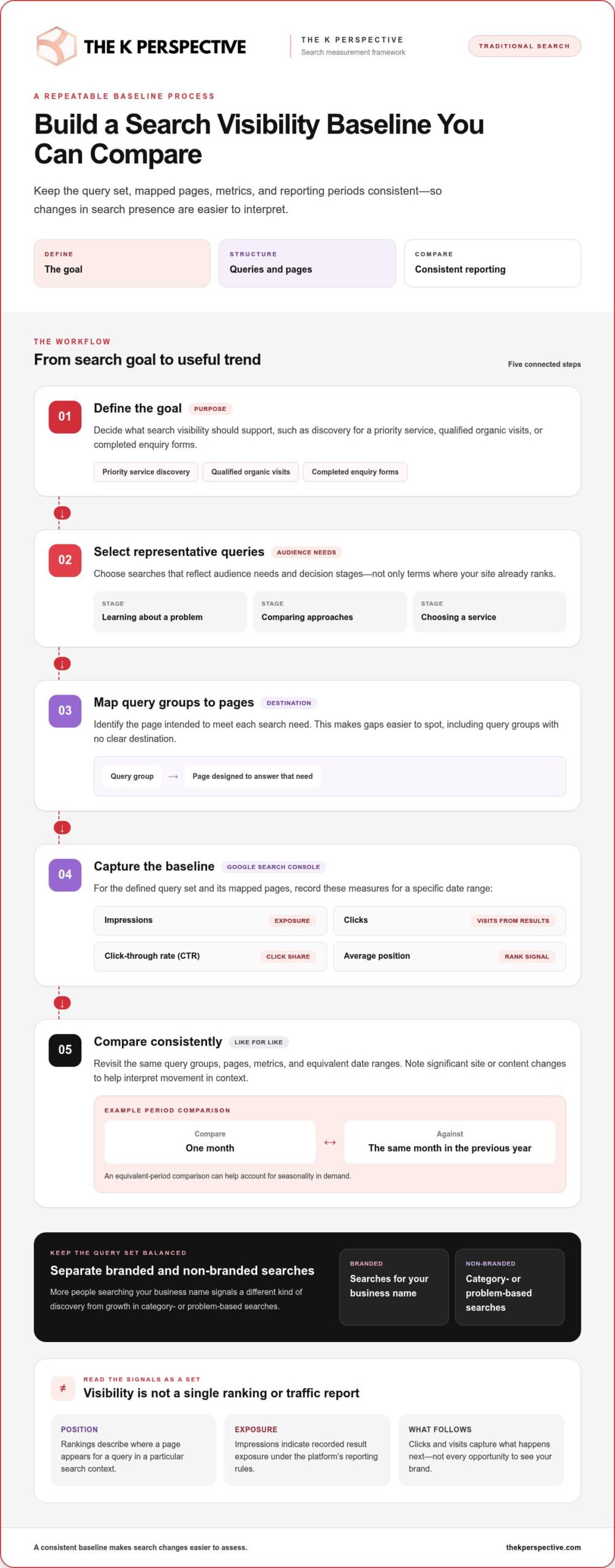
    1. Define the goal. Decide what search visibility should support, such as discovery for a priority service, qualified organic visits, or completed enquiry forms.
    2. Select representative queries. Choose searches that reflect audience needs and decision stages, not only terms where your site already ranks.
    3. Map each query group to a page. Identify the page intended to meet that search need. This makes gaps easier to spot, including groups with no clear destination.
    4. Capture a baseline. In Google Search Console, record impressions, clicks, click-through rate (CTR), and average position by query and page for a defined period.
    5. Compare consistently. Revisit the same query groups, pages, metrics, and equivalent date ranges. Note significant site or content changes so you can interpret movement in context.

    Build a representative query and page set

    Group queries by audience need, topic, and decision stage, such as learning about a problem, comparing approaches, or choosing a service. Map each group to the page designed to answer it. Keep branded searches separate from non-branded searches: more people searching your business name signals a different kind of discovery from growth in category or problem-based searches.

    Compare search performance without distorting the trend

    Compare equivalent periods, such as one month against the same month in the previous year, when seasonality may affect demand. Segment by query, page, device, and country when Search Console provides enough data to make the comparison useful. Note when you change a page, site structure, or content. These annotations help distinguish a performance shift from a change in what you’re measuring.

    Read average position as directional context, not a complete visibility score. It summarizes positions across impressions and can shift as your site appears for a different mix of queries. A stronger average position may coexist with fewer impressions, while a weaker average can reflect new exposure across broader searches. Check query-level and page-level details before deciding what changed.

    Then connect search exposure to on-site behaviour. In Google Analytics 4, review organic landing pages alongside engagement and relevant conversion events, such as a submitted enquiry form. Confirm that events represent actions meaningful to your business. Search Console shows how people encounter your results; GA4 helps you assess what happens after the visit. Neither replaces the other.

    The K Perspective’s Free Visibility Check offers an initial evaluation of your organic search presence.

    How to Measure AI Search Mentions, Citations, and Referral Visits

    AI search visibility needs its own observation method. A conventional rank tracker won’t show whether ChatGPT, Gemini, Perplexity, or another answer experience names your brand, cites your website, or sends a visitor to it. Track those signals separately, then connect them where the available evidence allows.

    A brand mention records that an AI answer names you; a source citation records that it references your content; a referral visit records a user arriving from that platform. Each is evidence of a different step in discovery, not proof of the next one.

    Create a repeatable AI search observation set

    Start with prompts based on genuine customer questions. Include informational, comparison, and vendor-selection prompts, then keep the wording steady between checks. For every observation, record the platform, date, exact prompt, whether your brand appears, whether your site is cited, and the answer context. Save a quotation or screenshot where appropriate so later reviews compare evidence rather than memory.

    Repeat prompts across selected platforms and dates. AI answers can vary between runs, even when wording stays the same, so a single spot-check isn’t a dependable trend. Treat results as directional samples, not a complete picture of every user’s experience or every answer a platform may generate.

    Separate AI discovery signals from attributable outcomes

    Use your analytics platform to identify visits attributed to AI services when referral information is available. In GA4, recognized AI sources may appear in referral data or its AI Assistant channel grouping; visits without referral information can still appear as direct traffic. Measured referrals are useful evidence, but they won’t capture every AI-influenced visit.

    Keep the measures distinct. A high mention rate with few citations suggests your brand appears in answers, but its website is less often used as a source. Citations with few referral sessions may still indicate exposure, while referral sessions without conversions show measurable visits but not necessarily business impact. Compare AI referral behaviour with other organic sessions, but don’t assume platforms provide equal attribution coverage.

    Signal What to record What it tells you
    AI mention Brand named and answer context Whether the brand appears in the response
    Cited source Website URL and cited passage Whether your content supports the answer
    Sentiment or stance Neutral, positive, negative, or recommended How the answer frames the brand
    Referral visit Sessions attributed to an AI source Whether measurable visits reach the site
    Conversion Relevant completed event Whether an attributed visit leads to an outcome

    For how to measure search visibility across traditional and AI experiences, use a shared prompt log alongside query and page reporting, but don’t force the signals into one score. Review mention frequency, citation quality, referral sessions, and conversions separately. Together, they show where your brand is present, what evidence supports that presence, and which activity can be tied to a site outcome.
    How to Measure Search Visibility in 2026: A Practical Framework

    How to Interpret Search Visibility and Choose Improvements

    Search metrics describe different points in a chain. Exposure shows that your result appeared. Position gives context for where it appeared. Clicks indicate a response, qualified visits show whether the audience fits, and conversions reveal whether the visit supported a business goal. A change in one signal doesn’t automatically explain a change in another.

    Use patterns to form questions, not jump to conclusions. High impressions with weak clicks may justify reviewing the result title and description, search intent, and results-page layout. If clicks are healthy but qualified visits are low, investigate whether the queries attract the audience you serve and whether the landing page delivers on the result’s promise.

    Signal pattern: Impressions rise, clicks stay flat. Check query intent, result presentation, and whether search features may affect visibility or click behaviour.

    Signal pattern: Clicks rise, qualified visits don’t. Compare the queries driving visits with your target audience, then review landing-page relevance.

    Signal pattern: Qualified visits rise, conversions don’t. Check whether the page makes the next step clear and whether the conversion event is measured correctly.

    Signal pattern: Visibility or citations fall. Compare the same queries, pages, platforms, and time periods, then investigate content, technical foundations, and changes in the search experience.

    Diagnose changes before calling them progress or decline

    Compare like-for-like query groups, pages, and date ranges before assigning meaning to a shift. Check seasonality, site or content changes, search result changes, and measurement coverage. If several factors changed together, treat the pattern as a clue, not proof of cause. Record what changed and test the most plausible explanation against subsequent data before making a larger adjustment.

    Prioritize visibility that serves the right audience

    Raw exposure matters less than relevant discovery. Prioritize query groups with a clear audience need but weak page coverage, then decide whether the gap calls for useful content, stronger technical foundations, or a clearer conversion path. This ties improvements to intent and business goals rather than a push for more impressions alone.

    Use a simple diagnostic sequence: identify the signal that moved, locate the query group and page behind it, check whether the change reached the intended audience, then choose one investigation or improvement. Impressions without clicks call for a different response than qualified visits without conversions. Keep the explanation proportionate to the evidence: correlation points to where to look, not necessarily what caused the result.

    The K Perspective’s Free Visibility Check can help turn these findings into a clearer improvement plan.

    Turn Search Visibility Measurement Into a Practical Growth System

    A measurement framework earns its value when it changes what you do next. A monthly review turns scattered reports into a decision record: what moved, what it may mean, and which action is worth taking. Keep the cadence steady, but adjust the depth of review to your publishing and measurement volume.

    Build a review cadence and decision record

    Use the same sources, definitions, and comparison periods from one review to the next. Document known limits, such as incomplete AI referral attribution or a recent change to conversion tracking. This context keeps comparisons honest and prevents reporting differences from being mistaken for performance shifts.

    1. Refresh the baseline. Update traditional search data and recorded AI prompt observations for the agreed reporting period.
    2. Compare the signals. Review exposure, position, clicks, relevant visits, citations, and business outcomes across matching query groups and pages.
    3. Investigate changes. Identify the pages or channels behind movement, then check relevant content, technical, audience, and measurement context.
    4. Prioritize an action. Choose a focused improvement based on audience relevance, business importance, and evidence from the baseline.
    5. Record the result. Log the finding, action, responsible owner, and next observation date. Use the next review to assess what changed, without assuming a single change proves cause.

    A concise dashboard should make these decisions easy. Organize it by query group, landing page, channel, and business outcome. Include the period being reviewed and relevant measures rather than blending unlike signals into one score. For example, show search impressions and clicks beside the intended page, with AI observations and attributable referrals in their own channel view.

    Move from measurement to a clear next step

    Prioritize gaps where the audience need is clear and the business relevance is strong. If important queries have no suitable page, investigate content coverage. If relevant pages aren’t appearing as expected, examine technical and organic foundations. If discovery brings qualified visitors but few meaningful actions, review the landing page and conversion path.

    Search Visibility Engineering can align technical and organic search foundations with target search intent. Your measurement record helps show where that alignment may be needed, instead of prompting broad changes based on a single metric. Keep the next action specific enough to review later: address a content gap for one query group, for example, then observe how its mapped page performs.

    A Free Visibility Check can help identify gaps in your organic search presence before you commit to broader optimization work. Use it as an initial evaluation after building your baseline.

    Make Your Next Search Decision Evidence-Led

    Your next step doesn’t need to be a complete overhaul. Choose one gap your measurement has surfaced, set a clear action, and use the next review to see what changed. That discipline turns search data into a working plan, not a report that gets filed away.

    The K Perspective’s Free Visibility Check offers an initial view of your organic search presence. Its Search Visibility Engineering aligns technical and organic foundations with the intent behind the searches you want to reach. Measurement is most useful when it guides the next decision.

    Get a Free Visibility Check and take your next step with a clearer view of where your search presence can develop.

    Frequently Asked Questions

    How do you measure search visibility for a website?

    Measure it by defining the searches and platforms that matter, then checking whether your site or brand appears and what happens afterward. To make how to measure search visibility practical, start with priority topics, identify the pages meant to address them, and review the same sources over comparable periods. Note site changes, campaigns, or seasonal events that could affect the pattern.

    Which metrics are most important for measuring organic search visibility?

    The most useful metrics depend on your goal, but a working set usually includes impressions, clicks, click-through rate, landing-page sessions, and relevant conversion events. Use impressions to understand exposure, then follow the path toward a meaningful action, such as a product enquiry or completed booking. Include engagement measures only when they help explain visitor behaviour; a high engagement figure alone doesn’t establish that visits came from your intended audience.

    Can you measure search visibility without tracking keyword rankings?

    Yes. Rankings provide useful context, but you can assess organic visibility through Search Console impressions and clicks, landing-page traffic, and the coverage of pages for important topics. A page receiving impressions for relevant queries is being surfaced, even if you don’t monitor each position in a rank tracker. Keep query or topic groupings consistent to understand which areas gain exposure and which remain difficult to discover.

    How do you measure visibility in AI search results?

    Use a documented prompt set based on questions customers ask, then review it on selected AI platforms. Record the exact wording, date, platform, whether the brand appears, any linked source, and the answer context. For example, note whether a response names your business as an option or cites a specific guide. Repeat checks before treating a pattern as meaningful, since an isolated answer is only one observation.

    Why are impressions increasing while organic clicks are falling?

    This can happen when your pages appear for more searches but attract fewer clicks from those results. A broader mix of queries, a less compelling result title, or search features that answer a question directly may contribute. Compare the queries and pages behind the change rather than relying only on total impressions. Check whether the added exposure matches your audience, and inspect the search results for those queries before revising page content.

    How often should you measure search visibility?

    For most sites, a monthly review is a useful starting point because it gives time to observe patterns without reacting to every short-term fluctuation. Sites publishing frequently or making substantial technical changes may benefit from closer monitoring of affected pages, followed by a consistent monthly comparison. Set the schedule based on how much new data you generate, and keep date ranges and metric definitions stable so each review remains comparable.

    Does search visibility guarantee more website traffic or leads?

    No. Greater visibility creates more opportunities to be discovered, but it doesn’t guarantee clicks, qualified visits, or leads. A searcher may find the answer without visiting, choose another result, or land on a page that doesn’t meet their need. Measure each stage separately and check whether the page, audience intent, and next step align. Treat visibility as an input to growth, not a promise of a particular business result.

  • Search Visibility Engineering: Build a System That Gets Your Business Found

    Search Visibility Engineering: Build a System That Gets Your Business Found

    What if your business ranks well but still isn’t part of the answer your next customer sees? Search visibility engineering addresses that gap. It looks beyond rankings to how your business is discovered, understood, trusted, and chosen across traditional search and AI-powered results.

    If your SEO work feels split between technical fixes, content production, and authority building, you’re not alone. Those efforts matter, but they work better as connected parts of a system. Conventional SEO often focuses on improving a page’s position. Search visibility engineering builds on that foundation, aligning site structure, useful content, credible signals, and conversion paths so visibility has a clear business purpose.

    This article explains the discipline in plain language and answers the central question: what does it do that conventional SEO doesn’t? You’ll see how discoverability, relevance, trust, and action fit together across search environments, what to assess in your current setup, and what a credible implementation approach looks like. The aim isn’t to chase every new search feature. It’s to build a sound system that helps the right people find your business and take a meaningful next step.

    Key Takeaways

    • Search visibility engineering connects technical foundations, relevant content, authority, and conversion into one coordinated system.
    • Assess discoverability, relevance, trust, and action together; a weakness in one layer can limit the value of the others.
    • Use rankings as one useful signal, then examine whether the right audiences find and consider your business across search environments.
    • Build a practical cycle: understand customer demand, assess your foundations, align existing assets, then review and refine.
    • AI Search Optimization works best as part of wider organic visibility, not as a promise of placement in any platform.

    Search Visibility Engineering: Why SEO Is Not Enough

    More rankings do not automatically mean more meaningful discovery. A page can appear prominently for a query yet fail to answer it, establish confidence, or make the next step clear. Visibility needs to work beyond the results position.

    Search visibility engineering is the coordinated design of technical foundations, useful content, authority signals, and conversion paths so a business can be discovered, understood, and considered across search environments. It treats visibility as a connected business system, not a collection of disconnected tasks. The goal is not to abandon SEO or chase every new platform. It is to connect sound search fundamentals to what people need and what they should be able to do next.

    How does search visibility engineering differ from SEO?

    SEO remains essential. Crawlability, indexing, relevant pages, and useful information give search engines a basis for finding and interpreting a site. A broad overview of search engine optimization principles helps explain these foundations. Search visibility engineering extends them by coordinating SEO with audience intent, authority, and the experience after discovery.

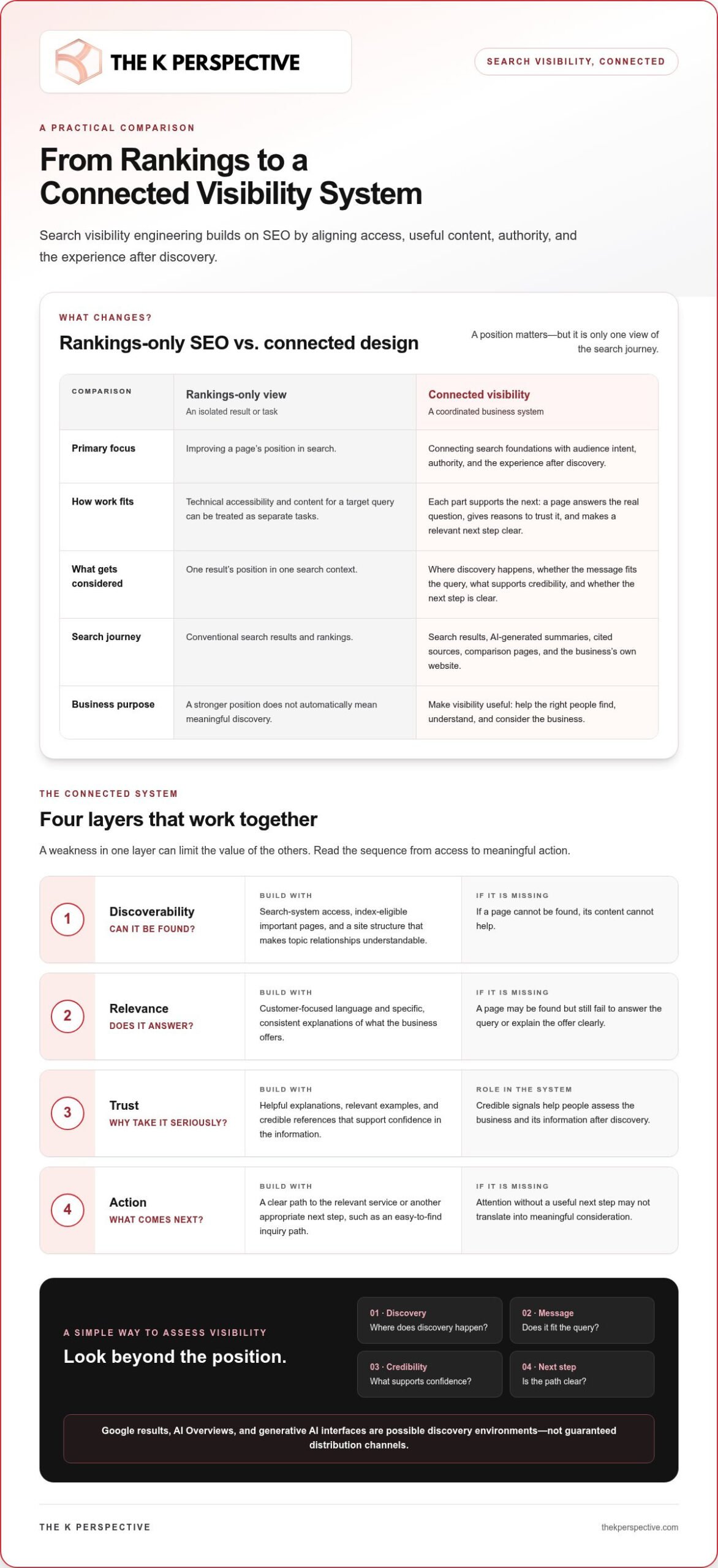
    Think of the difference as task-based optimization versus connected design. One task might improve a page’s technical accessibility. Another might add content for a target query. Both can be worthwhile, but their value depends on how they fit together. Does the page answer the real question? Does the business provide reasons to trust the answer? Can a reader easily find the relevant service or take another appropriate next step?

    For example, a service page may be technically accessible and appear in search results. If it answers a broad question with vague claims, visitors still lack useful guidance. If the page explains the service clearly but hides its inquiry path, discovery has not been connected to action. Engineering the system means making each part support the next.

    Why do rankings no longer describe the entire search journey?

    A ranking captures one view of one result in one search context. A person’s journey may also include a search results page, an AI-generated summary, cited sources, comparison pages, and the business’s own website. These formats can shape what someone understands before clicking, and they can appear in different combinations.

    That journey is rarely a straight line. Someone might discover a business through a search result, compare its explanation with other sources, then visit its site later to verify details. Another person may first encounter a summary and search the brand name afterward. Conventional search results remain part of the picture, but a position alone cannot show whether the business was visible in other relevant moments or whether its information helped someone evaluate it.

    Keep tracking rankings, but interpret them alongside the broader path: where discovery happens, whether the message fits the query, what supports credibility, and whether the next step is clear. That is the shift from measuring isolated SEO tasks to designing visibility with purpose.

    How Search Visibility Engineering Connects Discoverability, Relevance, Trust, and Action

    Search visibility works as a sequence of connected layers. A business first needs to be accessible to search systems. Its pages then need to make clear what the business offers and which questions they answer. Useful content and credible references help support trust, while a clear next step gives interested visitors somewhere relevant to go.

    Search visibility depends on alignment between access, meaning, evidence, and next steps. If a page can’t be found, its content can’t help. If it’s found but doesn’t answer the query, authority signals may bring the wrong attention. If it earns attention but offers no useful next step, visibility may not translate into meaningful consideration.

    What makes a business discoverable and understandable?

    Discoverability starts with the basics: search systems need access to pages, important pages need to be eligible for indexing, and the site structure should make relationships between topics understandable. These foundations support visibility in Google and can also help other information systems interpret a site. Google’s Search Essentials and best practices provide guidance on accessible pages, clear content, and user-focused search practices.

    Meaning comes next. A service page should use language that reflects what customers actually seek, then explain the offer in specific, consistent terms. If the business describes the same service in conflicting ways across its pages, it becomes harder for people and systems to understand how those pages relate. Structured information can reinforce that clarity, but it can’t compensate for thin or ambiguous content.

    Google results, AI Overviews, and generative AI interfaces are examples of places where clear, relevant information may be encountered. None is a guaranteed distribution channel. The practical aim is to make the business’s information coherent and accessible, rather than building around the assumption that one format will always feature it.

    How do authority and conversion complete the system?

    Once a business is understandable, its content must give people a reason to take it seriously. Helpful explanations, relevant examples, and credible references from outside the site can provide evidence that supports recognition and trust. These signals may contribute to how a business is interpreted, but they don’t guarantee a citation, recommendation, or commercial result.

    Then connect each landing page to an appropriate action. A page answering an early research question might point readers to a related guide. A page for people evaluating a service might make the inquiry process clear. The action should match the visitor’s intent, not force every reader into the same sales step.

    Measure visibility and business impact separately. Impressions, rankings, and citations indicate exposure; completed inquiries or other meaningful actions show what happened after exposure. Tracking both helps reveal where the chain is working and where it needs attention. To get a starting view of your organic presence, The K Perspective’s Free Visibility Check can help assess it.

    Search Visibility Engineering vs. Rankings-Only SEO: What Should Businesses Evaluate?

    Rankings still matter. They can show whether a page is appearing for a target query and help identify changes worth investigating. But a position on a results page doesn’t explain whether the query matches your audience, whether your business is visible elsewhere in the journey, or whether people take a relevant next step.

    Rankings describe one outcome; engineering aligns the system that can influence discoverability. The difference isn’t a new label for familiar tasks. It’s whether the work connects technical decisions, audience intent, content, authority, and action, then uses evidence to guide what happens next.

    Evaluation area Rankings-only SEO Search visibility engineering
    Focus Positions for selected queries Whether the right audience can find, understand, and evaluate the business
    Work coordination Tasks may be tracked separately Technical work, content, authority, and conversion are planned in relation to each other
    Visibility surfaces Primarily organic search positions Organic results and other relevant discovery formats, including AI-generated summaries and citations
    Interpreting results Position changes are a central measure Rankings are considered alongside exposure, audience quality, and user actions

    Which signals reveal a wider visibility picture?

    Use rankings as a diagnostic, not a verdict. Consider whether relevant search impressions are growing, whether visits match the intended audience, whether people search for the brand, whether it appears as a citation, and whether landing pages make a suitable action clear. These signals answer different questions. A citation indicates visibility in a particular answer experience; it doesn’t, by itself, show trust, a qualified visit, or business impact.

    Measurement options vary by platform. An impression in one search product isn’t automatically comparable with a citation or visit elsewhere, so avoid combining unlike figures into a single score without context. For each measure, record what it represents, which platform it comes from, and what period you are comparing. The useful test is whether the evidence connects exposure to meaningful audience behaviour.

    How can businesses separate engineering from industry hype?

    Ask to see the logic behind the work. A credible plan should show how a technical priority supports a real audience need, how content answers that need, what evidence supports authority, and what action the page should enable. Priorities should be explainable, sequenced, and reviewed against observed results.

    Be skeptical of guaranteed rankings, citations, or traffic. Search systems and user behaviour aren’t fully controlled by an implementer. A sound approach sets clear objectives, documents what is changing and why, then adjusts based on evidence. It doesn’t treat every new platform as an urgent project. That’s the substance of search visibility engineering: coordinated decisions, transparent priorities, and measured iteration.

    Search Visibility Engineering: Build a System That Gets Your Business Found

    How to Build a Search Visibility Engineering Cycle Without Chasing Every Trend

    A useful search strategy doesn’t begin with a platform announcement or a long list of keywords. It begins with business priorities and evidence. This four-stage cycle keeps the work focused: understand demand, assess foundations, align assets, then review and refine.

    1. Understand demand. Identify priority audiences, the questions they ask, and what they need to know at each decision stage. Separate research questions from service comparisons and inquiry-ready intent. Prioritize questions that connect to your offer and customers’ decisions, rather than publishing a page for every variation of a query.
    2. Assess foundations. Review whether important pages are accessible and useful, whether the site makes its topics and services clear, and whether existing visibility reflects the audiences you want to reach. Distinguish confirmed structural problems from short-term ranking movement or a change in one search platform.
    3. Align assets. Map each priority need to an existing page, content gap, authority signal, or relevant next step. Improve or connect assets before creating more. A page that already serves a customer need may be more valuable to refine than a new article on a loosely related topic.
    4. Review and refine. Choose an observable signal for each change, such as relevant impressions, qualified visits, or completed inquiry actions. Review patterns over time, document what changed, and adjust. A change followed by a result isn’t proof that the change alone caused it, so interpret evidence carefully.

    What should a business map before changing its search strategy?

    Start with a simple audience-to-asset map. Note who you want to reach, the questions they ask, what evidence helps them decide, and which pages currently serve those needs. Include external visibility, such as credible references or relevant citations, where you can observe it. The map should expose gaps and overlap, not become an inventory for its own sake.

    Then separate durable issues from temporary movement. An important page that can’t be accessed is a foundation concern. A brief position change, by itself, may not be. Check the context before redirecting resources or rewriting content in response to a fluctuation.

    How should teams prioritize and review the work?

    Resolve foundational blockers before expanding into more topics or platforms. Give every planned change a clear purpose: which audience need does it serve, what will change, and what observable signal would indicate progress? This makes priorities easier to explain and prevents activity from becoming the measure of success.

    Keep a concise record of changes and review trends alongside relevant business actions. For each change, note the page or system affected, the reason for the change, and the signal you expect to monitor. Search visibility engineering becomes practical when each stage informs the next, rather than prompting another disconnected task.

    If you want a starting view of your organic search presence, begin with the Free Visibility Check.

    How The K Perspective Approaches Search Visibility Engineering as a Connected Growth System

    The K Perspective is a founder-led search visibility and digital growth consultancy. Its approach connects technical search foundations with strategic content, authority, AI search optimization, and conversion-focused website systems. The point is coordination: each part supports a clear role in helping a business become easier to discover, understand, and consider.

    That matters because a technically sound site can still leave audience questions unanswered, while useful content may have limited reach if search systems can’t access or interpret it. Search visibility engineering brings these decisions into one plan, so priorities are tied to business goals rather than treated as isolated deliverables.

    What does an integrated search visibility approach bring together?

    SEO provides essential foundations, including accessible pages and relevant content. Search Visibility Engineering connects those foundations to audience-focused content that responds to real questions and commercial intent. Authority content and publishing add useful evidence beyond the website, while AI Search Optimization considers how information may be interpreted in generative search experiences.

    These elements work alongside one another, not as separate promises of placement. Google results, AI Overviews, and generative AI interfaces are different discovery environments, and no strategy can guarantee that a business will appear in a particular feature. The practical focus is clear, consistent information that supports organic visibility across relevant search contexts.

    Discovery is only part of the system. Conversion-focused website systems help make the next step understandable, whether a visitor is reviewing a service, exploring a relevant resource, or considering an inquiry. A page should connect what brought someone there with an action that fits their needs. That alignment makes the journey more coherent without assuming every visitor is ready to take the same step.

    What is a practical first step for assessing visibility?

    The Free Visibility Check offers an initial way to assess a business’s organic search presence. It can provide a starting point for identifying where visibility and business priorities may need closer attention, without promising a particular ranking change, AI citation, increase in traffic, or lead outcome.

    Before beginning, clarify your main business goal and the audience you most want to reach. Note the questions those people ask and the services or information they need to evaluate. That context helps keep the assessment grounded in what matters to your business, rather than in a generic checklist or the latest platform trend.

    If you’re ready to examine your organic presence, request a Free Visibility Check. It’s a practical place to begin connecting search foundations, content, authority, and conversion around a shared growth objective.

    Make Your Next Search Decision Deliberate

    The next step isn’t to add another tactic to the queue. Choose a business priority, identify where people struggle to find or assess your offer, and use that gap to guide your next improvement. This keeps search visibility engineering tied to decisions your team can evaluate, not activity that looks busy but leaves the customer journey unchanged.

    The K Perspective connects search strategy, technical and organic foundations, content, authority publishing, AI search optimization, and conversion-focused website systems. The Free Visibility Check offers a practical starting point for assessing your organic search presence. It’s an assessment, not a promise of a particular ranking, citation, or commercial result.

    Bring your priority audience and business goal into the process. That context can help clarify what to strengthen first and how to assess progress without chasing every new search feature. Request a Free Visibility Check and take the next step with a grounded view of your visibility. A stronger system starts with one clear decision, and you can build from there.

    Frequently Asked Questions

    What is search visibility engineering?

    Search visibility engineering is an integrated approach to making a business easier to find and assess across search environments. It connects accessible technical foundations, relevant pages, evidence of expertise, and useful next steps. It includes SEO rather than replacing it. For example, a business can align a service page with the questions prospective clients ask, then make its inquiry process clear. The approach doesn’t guarantee rankings or citations.

    Is search visibility engineering just another name for SEO?

    No. SEO is a core discipline, while the engineering lens coordinates it with content planning, authority development, changing search surfaces, and the visitor’s next step. For example, fixing a page’s indexability is SEO work; deciding how that page supports a buyer’s research and where it leads them is part of the wider operating model. The distinction is practical, not semantic. A new label adds little unless decisions become better connected.

    How is search visibility engineering different from traditional SEO?

    The difference is in how the work is planned. Traditional SEO may focus on discrete improvements such as page titles, links, or load performance. Search visibility engineering connects those changes to a discovery path, from a relevant query to a useful page and a credible next action. Rankings remain a valuable diagnostic, but a strong position for an unrelated query may not reach the intended audience or help them assess the business.

    Can search visibility engineering help a business appear in AI search results?

    Clear, accessible pages, consistent descriptions of services, and credible references can help AI systems interpret a business and its expertise. For instance, service pages that explain who each service is for provide clearer context than a site relying on broad slogans. Search visibility engineering can strengthen these foundations, but no practitioner can guarantee a specific AI citation, recommendation, or result across platforms. Treat AI visibility as an area to support and monitor, not a placement promise.

    How long does search visibility engineering take to work?

    There’s no fixed timeline. The pace depends on the site’s starting condition, the work required, the competitive environment, and how quickly search systems respond to changes. Technical implementation milestones, such as publishing a revised page, can be tracked directly. Changes in visibility or business activity need observation over time. Separate completion of planned work from evidence of impact, and avoid treating an early movement in rankings as proof of lasting progress.

    How can a business tell whether its search visibility strategy is working?

    Review relevant visibility, qualified visits, audience fit, citations where measurable, and conversion behaviour together. For example, more visits may not be useful if they come from queries unrelated to the business’s services. Metric availability differs across platforms, so don’t treat every impression or citation as directly comparable. Look for patterns, record changes, and avoid assuming one change caused a result. For each metric, note what it measures and which platform it comes from.

    Does a small business need search visibility engineering?

    A small business can scale the approach to its goals and available resources. It doesn’t need to target every platform or publish about every possible query. Start with the audience you most want to reach, make sure important pages are accessible, and improve the pages that support key customer decisions. Give each priority page a clear purpose and a relevant next step. This creates a manageable foundation that can expand as needs and capacity grow.